

How do I know if my breastfed baby is getting enough to eat?
If you are breastfeeding (all the time or just some of the time), it can be really hard to tell how much your baby is eating. (Obvi- the breasts do not have ounce markers on them). Good news, there are four tell-tale signs your baby is getting enough the eat.
Four Signs Your Breastfed Baby is Getting Enough to Eat
1. Regular swallowing while feeding
Your baby will start off with a few quick suckles and then transition to bursts of several sucks with long, drawing jaw movements (or a jaw drop) that signs the baby swallowing.
Listen and look for the “jaw drop”/swallow in this video here, courtesy of Global Health Media.
Your baby’s swallows sound like a quiet “cah” sound. It’s normal to hear more swallows in the first 5-10 minutes of a feed.
If baby’s swallows have slowed at the start, try “breast compressions” (think of cake frosting bag, gently squeezing milk out from the top the bottom, push down for a few seconds, then let go when swallows resume).
2. Contentment between feeds
Your baby should end the feed with their body relaxed. Look at their hands and shoulders. Are they still tensed(hungry)? or open and softened (satisfied)?
In the first few weeks, your baby will sleep for an amount of time before waking again to feed. It could be 30 minutes, it could be 2 hours. If they’re hungry 5 minutes after you end the feed, they probably did not get enough during the feed.
3. Steady weight gain
If your baby was born full term, your baby should gain about an ounce a day (or 5-8 oz a week) for the first month.
If you are on a specific feeding plan due to baby’s weight or gestational age when born, please follow your pediatrician’s guidance.
4. Diaper output
Pro Tip: use a feeding log in the first two weeks, so that you can track feeds, as well as wet and stool diapers.
Wet diapers: You should see 1-3 wet diapers on days 1-3 (one on day 1, two on day 2, three on day 3), and 4-6 wet diapers by days 4-6. After day 6, you should see at least 6-8 wet diapers in 24 hours. Your baby’s urine should be clear or light yellow.
Some diapers will be mixed with both urine and stool.
Stool diapers: Your baby should have 3-4 stool diapers in 24 hrs.
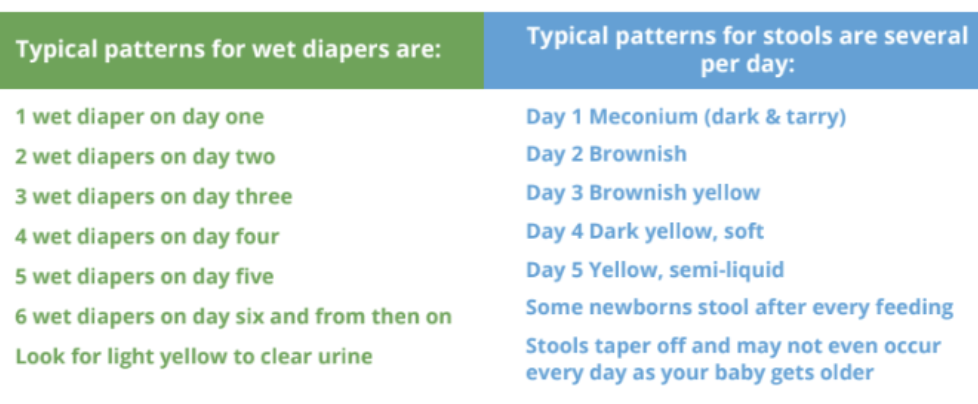
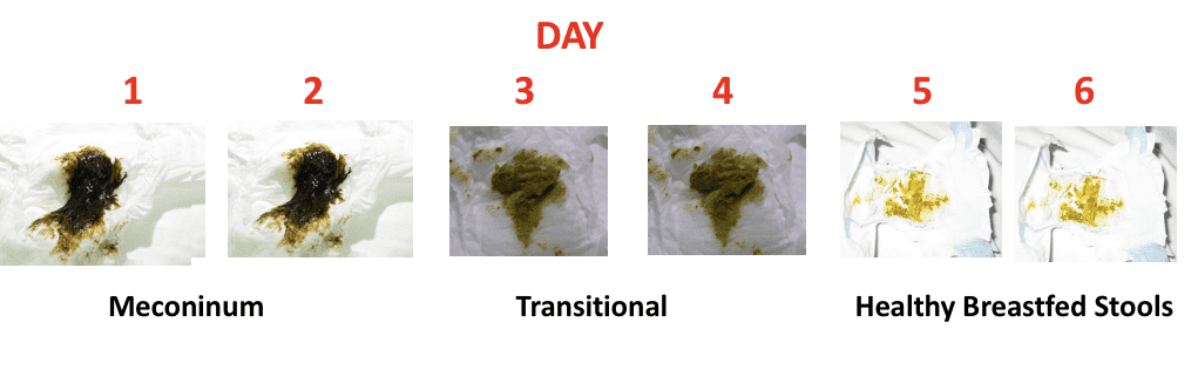
In order to help your baby eat enough, offer the breast regularly. If your baby is not waking up on their own for feed, wake them to feed at least every 3 hours (from start of feed to start of feed, ex: 9 am, 12 pm, 3 pm). Most breastfed babies will eat 10 or more times in 24 hours, spaced about 2-3 hours apart and sometimes closer closely together in the evening (“cluster feeding”). Overnight, talk to your pediatrician. They may want you to feed every 3 hours to regain their birth weight. Otherwise, they may say that your baby can do one 4 or 5 hour stretch per 24 hrs until breastfeeding is well-established and your baby is growing well.
Source, Making More Milk: The Breastfeeding Guide to Increasing Your Milk Production, Lisa Marasco
When to ask for help from an IBCLC
Not seeing or hearing swallowing or only a few swallows when nursing
Less than expected number of wet and or poopy diapers (fewer than 3 wet diapers on day 3, or seeing black tarry poop/meconium day 5)
Nipple pain or damage
Trouble latching
Needing to supplement with milk other than your own
Baby falls asleep without nursing and is difficult to wake up.
Written by Kathleen Stern (bio here). For more infant feeding and parent support, reach out to Kathleen at www.strongnestconsulting.com
Last updated December 14, 2025